Leather Care
What Is PU Leather? How It Compares to Real Leather
PU leather is a plastic coating on a fabric backing. Here is how it is made, how it differs from real leather, and how to spot it in a shop.
At a glance
- PU leather is a plastic coating on a fabric backing, not hide.
- Check the edge and the back: a fabric backing means PU.
- PU wipes clean but cracks and peels over time.
- Real leather pays off on wallets and bags you handle every day.
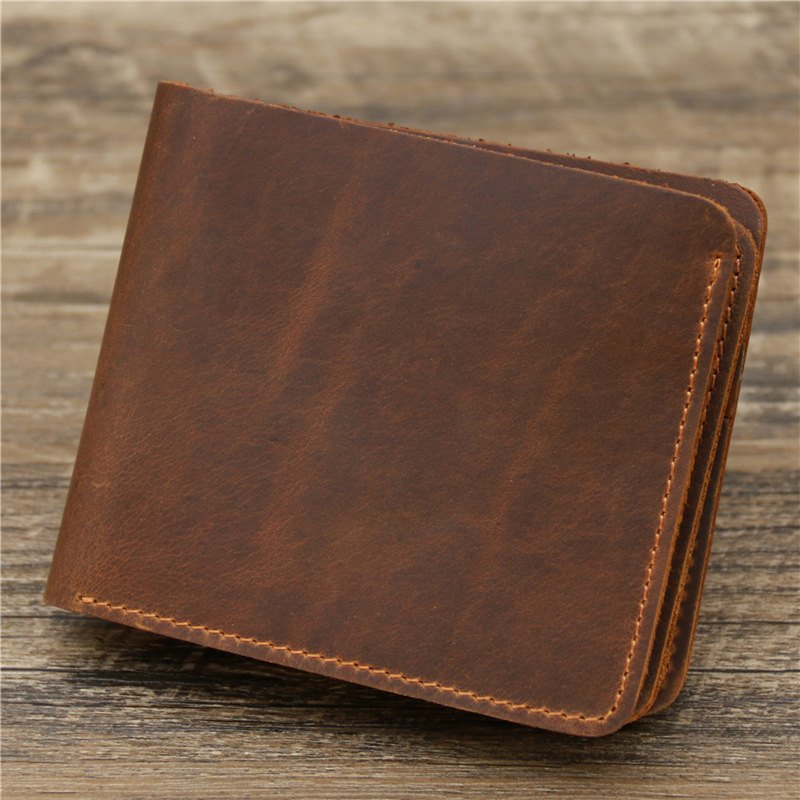 Crazy Horse Leather Bifold Wallet for Men, Red Brown £32.99 · Free UK delivery Shop
Photo: Edward Cwik, CC BY-SA 3.0, via Wikimedia Commons
PU leather is a fabric backing with a polyurethane (PU) plastic coating, embossed to look like leather. It has no tanned hide on the surface. It is cheaper than real leather and it ages differently.
This guide explains how it is made, how it differs from real leather and where each one makes sense. Two of our own products use PU, so we say plainly where that is a good choice.
At a glance
- PU leather: plastic surface on a fabric or split-leather base.
- Faux leather: any imitation leather. PU is the most common kind.
- Genuine leather: real hide, of any grade.
- Full-grain leather: real hide with the natural surface kept.
- Bonded leather: leather scraps glued together with a binder.
How PU leather is made
PU leather is made by coating a base material with liquid polyurethane. The base is usually a woven or knitted fabric. The coating is set and then embossed with a pattern that copies a grain.
The result looks uniform. Real hide has marks, pores and small variations. PU has a pattern that repeats.
Some products use a split of real leather as the base and put a PU layer on top. The base is leather, but the surface is plastic.
Bonded leather, bicast and split leather
Bonded leather is not solid leather. It is leather scraps and fibres combined with a binder and finished with a surface layer. American Leather, a furniture maker, calls it the least pure form of leather and the most cost-effective.
Split leather is the lower, fibrous layer of the hide left after the top is separated. It is real leather, but the same guide notes it lacks the durability and look of the higher grades. Bicast leather is split leather with a PU layer on top. It is the semi-synthetic type described above.
Treat these as the cheap end of the range. A product called “bonded” or “bicast” is not the same as a full-grain one.
Full-grain, top-grain and genuine leather
Full-grain leather is the outer layer of the hide with only the hair and epidermis removed. The natural surface stays. American Leather quotes the Tanners’ Council for this definition.
Top-grain has no firm definition. The same source calls it a vague term and says it is merely a euphemism for “not full grain”. Ask what the seller means by it.
Genuine leather simply separates real leather from synthetic. It indicates authenticity, not quality. So the answer to “genuine leather vs real leather” is that they mean the same thing. A “genuine leather” label can sit on a high grade or a low one.
For how origin and tanning change real leather, see our guide to Italian leather vs English leather.
PU leather vs real leather
Real leather ages and PU leather wears out. That is the main difference. The table covers the rest.
| PU leather | Real leather | |
|---|---|---|
| Feel | Smooth and even, a little plasticky | Varies by hide, warms in the hand |
| Ageing | Cracks or flakes at the surface | Marks and darkens into a patina |
| Lifespan | Shorter, depends on flexing | Longer with care |
| Care | Wipe clean, no conditioning | Wipe, then condition now and then |
| Price | Lower | Higher |
| Water | Spills bead and wipe off | Can stain or mark, needs care |
| Breathability | Little | Some |
The faux leather vs real leather question comes down to what the item does. PU suits things that sit still. Real leather suits things you handle every day.
How to spot PU leather in a shop
You can usually tell by looking at the edge and the back. Run through this checklist.
- Check the edge. Real leather has a rough, fibrous edge. PU shows a smooth plastic layer sitting on fabric.
- Check the back. A woven or knitted fabric backing means PU. Real hide has a suede-like, fibrous back.
- Look at the grain. If the pattern repeats exactly across the surface, it is embossed.
- Press the surface. Real leather wrinkles in fine, irregular lines. PU creases more uniformly or just flexes.
- Smell it. Real leather smells of tanning. PU smells faintly of plastic or of nothing.
- Read the label. “Man-made”, “vegan”, “PU” and “leather look” all mean plastic.
- Drop some water on it. On PU it beads. On untreated real leather it soaks in slowly.
No single test is certain. Use two or three together.
Durability, peeling and care
PU leather fails at the surface. The plastic coating cracks and flakes away from the backing, usually at folds and edges. Heat, sunlight and constant bending make it worse. Once it starts, it cannot be repaired well.
Care is simple. Wipe it with a slightly damp cloth and dry it. Do not use leather conditioner, as it does not soak into plastic. Keep it out of direct heat. Our faux leather valet tray is a PU piece with a microsuede lining. Its product page says to wipe the exterior with a damp cloth and to avoid soaking it.
Real leather needs a little more. Wipe it, let it dry naturally and add a conditioner every few months.
The UK labelling angle
UK law defines leather tightly for footwear. The Footwear (Indication of Composition) Labelling Regulations 1995 set these terms:
| Label term | What it allows |
|---|---|
| Leather | Real hide with a surface coating or glued-on finish no thicker than 0.15mm |
| Coated leather | Real hide with a thicker coating, up to one third of the total thickness |
| Not leather | Hide broken down into fibres and re-formed |
The label must name the material that makes up at least 80% of the upper, of the lining and sock, and of the outer sole. If no material reaches 80%, it names the two main materials.
These rules cover footwear. We could not find an equivalent single rule for wallets or boxes, so check the product description for the material. You can read the regulations on legislation.gov.uk.
Where PU is a sensible choice
PU is a good choice for items that roll, fold or sit still. It costs less and wipes clean.
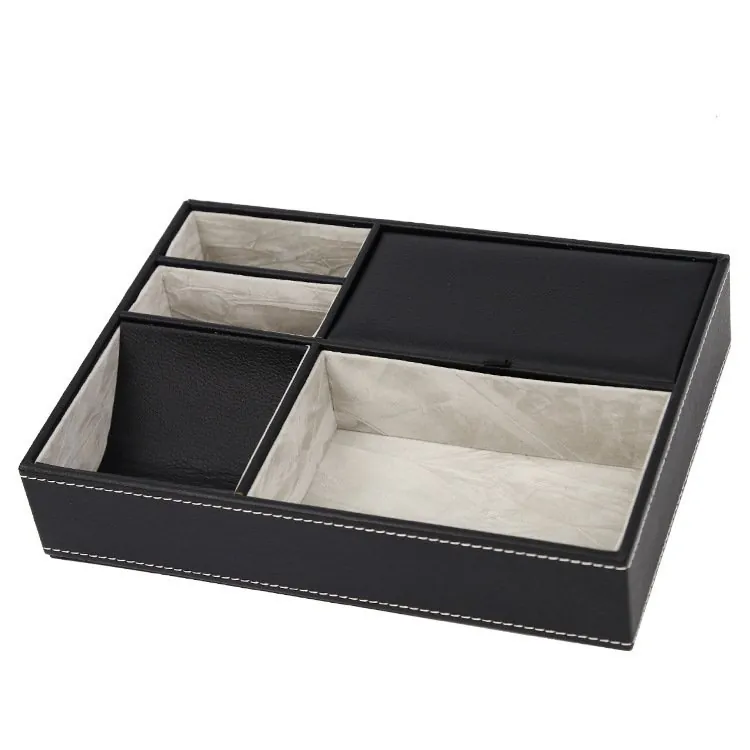
Our PU leather watch roll has a premium PU leather exterior, a microsuede lining, foam padding and brass snap closures. It rolls down to 11cm x 8cm x 8cm. A roll needs a material that bends freely, and PU does that at the price. The valet tray above is the same story: a PU exterior over an MDF base, with a lining that will not scratch a watch.
Boxes, trays, linings and travel organisers are all fair uses. They are not handled the way a wallet is.
Where real leather pays off
Real leather pays off on items that live in a pocket or a bag, because they are handled every day. Wallets and bags wear at the same points all the time, and real hide wears in rather than out.
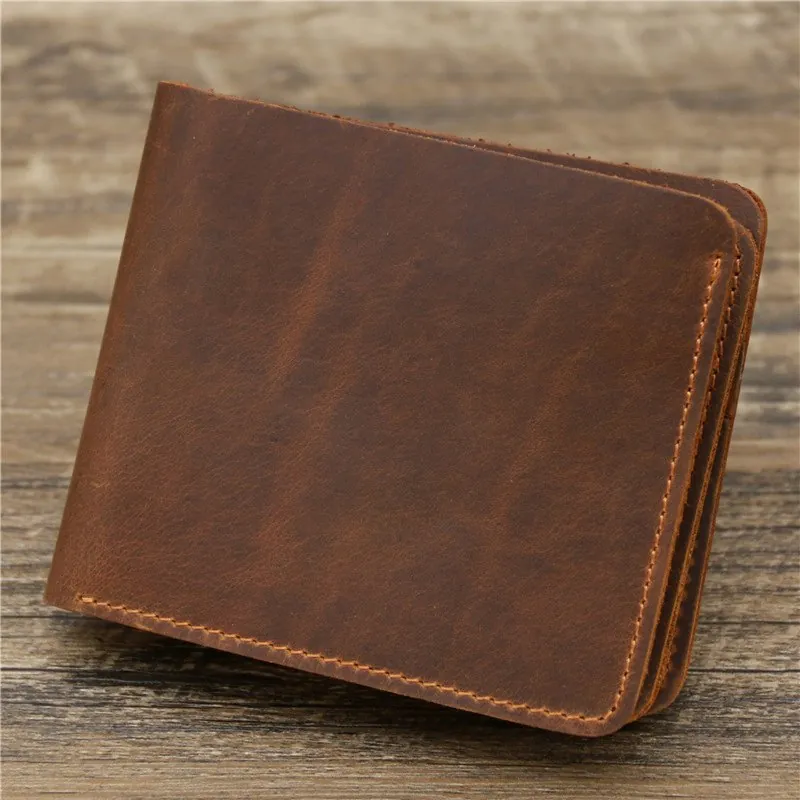
Our crazy horse leather bifold wallet is made from crazy horse leather (top-layer cowhide). Its product page says the colour lightens where it bends or rubs, so it looks more worn in with use. Our leather trifold RFID wallet in dark brown is genuine cowhide leather with an RFID blocking lining and a fabric interior.
If it goes in your pocket daily, buy real leather. If it sits on a shelf or in a case, PU is fine.
Questions answered
Is PU leather real leather? +
No. PU leather is a polyurethane plastic coating on a fabric backing. Some versions use a thin layer of leather as the base, but the surface is still plastic.
Is faux leather the same as PU leather? +
Mostly. Faux leather is the general term for any imitation leather. PU is the most common type, and PVC is the other one you will see.
Is genuine leather the same as real leather? +
Yes, both mean the material is real animal hide. Genuine leather says nothing about quality, because the term also covers lower layers of the hide.
Does PU leather peel? +
Yes, eventually. The plastic surface can crack and flake away from the backing, especially on items that bend or rub every day.
Is PU leather waterproof? +
It sheds spills well because the surface is plastic. Soaking it is still a bad idea, as water can reach the backing and any padding underneath.